Scrum solved something genuinely hard. Inside a sprint, a team's capacity is understood, commitments are visible, and WIP is bounded. For a single team working on well-defined work, this is a real achievement. Most large software organizations have this working reasonably well at the team level.
Go up one level to program or portfolio, and the picture breaks down completely.
Why portfolio-level workload is so hard to see
In large, complex delivery systems, work at the program and portfolio level does not behave like sprint tasks. A business objective might span four teams, two platforms, and a third-party dependency. Part of it is in research. Part is in active development. Part was deprioritized six weeks ago but never formally removed from the roadmap. Asking "what is the status of this objective?" produces a different honest answer depending on who you ask and which slice of the work they own.
Priorities compound the problem. In fast-moving organizations, strategic priorities shift mid-quarter. Features that were started get put on hold, but the capacity already allocated to them does not automatically free up. Work that is "paused" still consumes coordination overhead, still occupies engineers in status conversations, and still appears as active on the roadmap. The in-flight count grows. Actual throughput does not.
SAFe introduced Program Kanban and Portfolio Kanban boards specifically to address this. The intent was sound: make work visible at every level, apply WIP limits across the program increment, and give leadership a real view of what is actually in flight. In practice, these boards are among the least maintained artifacts in most scaled organizations. They require discipline to update, political will to enforce, and someone with enough authority to say "nothing new starts until something finishes." That combination is rare.
The result is a system where team boards are accurate and portfolio boards are aspirational. Work accumulates in the pipeline faster than it exits. The overload is real but invisible. That condition has a name.
Workload Saturation: when the system drifts into USC-1
When a delivery system consistently carries more parallel commitments than it has capacity to progress, it has drifted into an Unintended System Condition (USC) called Workload Saturation. This is not a one-time planning mistake. It is the default output of a system that has no reliable mechanism to limit what enters the pipeline relative to what it can actually deliver.
This USC builds gradually. It rarely announces itself. What announces itself are the symptoms.
How this USC shows up as recurring symptoms
These patterns appear consistently in organizations carrying more portfolio load than the system can sustain. They are not isolated incidents. They are the recurring surface of the Unintended System Condition (USC) operating underneath.
Planning sessions open with a capacity negotiation that should not be necessary if commitments were realistic. The same people appear in every cross-team conversation, because every initiative depends on the same three architects, the same platform team, the same security review queue. Decisions that should take days take weeks, not because anyone is avoiding them, but because the people who need to make them are simultaneously committed to too many other things.
Dependencies get "managed" rather than resolved. Tracked, escalated, color-coded on a status report, and carried into next quarter's planning where they appear again. Every initiative is technically "in progress." Almost nothing is finishing at the rate anyone planned.
Engineers report feeling overloaded despite sprint boards that look reasonable. The hidden load is in the cross-team coordination, the context switching, the urgent requests that land outside any tracked system. Teams are working hard. Sprints are completing. And somehow the program is always behind.
These are not performance problems. They are the observable surface of a system condition that originates above the team level.
The visual below shows what most organizations are missing
SAFe designed Program and Portfolio Kanban boards to solve exactly this problem. The left panel shows what those boards are intended to do: WIP limits enforced at each stage, work distributed across states, portfolio genuinely visible. The right panel shows what most organizations actually maintain.
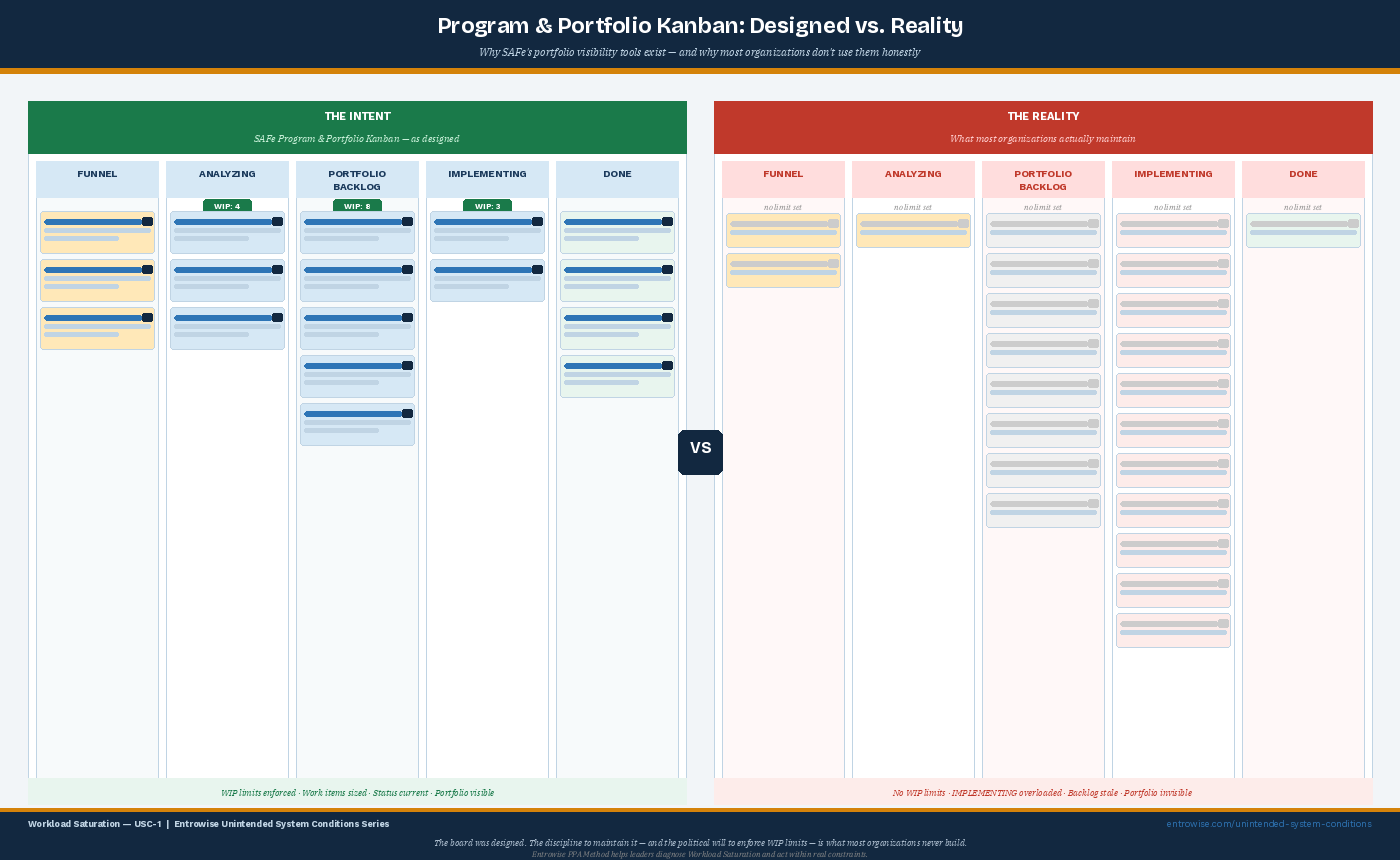
The board was designed. The discipline to maintain it, and the political will to enforce WIP limits at the portfolio level, is what most organizations never build. Not because the tools are unavailable, Jira Advanced Roadmaps, Azure DevOps, Aha, and Linear all support this, but because an honest board makes visible the commitments made in separate conversations without anyone checking whether the system could hold them all. That picture requires a trade-off conversation most organizations have been deferring for months.
The principles being violated
Workload Saturation is not bad luck. It is the predictable output of a system consistently ignoring two cause-and-effect relationships.
Limit WIP: At the team level, most Scrum teams understand sprint capacity. Kanban teams set explicit WIP limits per column. But at the program and portfolio level, WIP limits are rarely defined or enforced. What would they look like in practice? A program-level WIP limit might say: no more than six capabilities in active development simultaneously across a program increment. A portfolio-level limit might say: no more than three strategic initiatives in the build phase at any given time, with new initiatives entering only when one exits. These numbers are not arbitrary. They are calculated from actual team capacity, dependency load, and historical throughput. Without them, intake is effectively unlimited, and the system fills to saturation by default.
Constraints Create Focus: When demand at the portfolio level is unconstrained, trade-offs never get made. Everything remains theoretically in flight. Organizations do not become more ambitious when portfolio intake is unlimited. They become less effective, because the system optimizes for starting work rather than finishing it.
Both principles are violated the moment a portfolio review adds a new initiative without pausing or closing another.
A real constraint most organizations face
Understanding Workload Saturation as a USC is one thing. Acting on it runs into real organizational constraints, and it is worth naming one directly.
Incentive misalignment is among the most common and least discussed drivers of this USC. Portfolio leaders are typically measured on how many strategic initiatives they sponsor and progress, not on how many the system can realistically deliver. Adding work to a roadmap is visible, credited, and rewarded. Saying "we cannot take on another initiative this quarter because the system is already full" is a harder conversation with no immediate organizational reward. That incentive structure means Workload Saturation rebuilds itself even after it gets cleared. The portfolio fills again because the conditions that filled it have not changed.
This constraint is not easily eliminated. Incentive structures are organizational choices, but they are choices with political weight and historical momentum. They are mitigable, however. When portfolio reviews are redesigned to surface actual system load alongside strategic ambition, when initiative approval requires an honest capacity check, and when leaders are recognized for delivery reliability rather than roadmap volume, the incentive gap narrows. The USC becomes less likely to return.
The question worth asking in your next planning session
The coaching question that changes this conversation is not "why is the team behind?" It is: how many real commitments does this system have in flight right now, counted in actual team hours and shared dependencies, not slides?
Most leaders who answer that honestly find the number is two to three times higher than the system can deliver in the timeframe planned. That gap is not an execution failure. It is a design condition. And design conditions can be changed.
The Entrowise AI Diagnostic Tool helps you identify which Unintended System Conditions (USCs) are active in your delivery system, which principles are being violated, and what action is realistic within your actual constraints: entrowise.com/AI-diagnostic-coaching-tool