Every RACI chart makes a bet nobody states out loud: that responsibility and accountability travel together because a single person stands behind both letters. Assign someone as Responsible and they do the work. Assign someone as Accountable and they own what the work produces, explain it when asked, and adjust when it goes wrong. For forty years this bet paid off, because the only actors capable of holding either letter were human, and a human who does the work is usually able to answer for it too. Agentic AI is the first thing to test the bet directly, and it is failing.
What Accountability Actually Does
Accountability was never really a box on a chart. It was a capacity: the capacity to explain a decision after the fact, to absorb the consequence of it, to change behavior once the consequence is understood. RACI let organizations skip defining that capacity explicitly, because a person always sat behind the letter, and people carry explanation and consequence by default. Nobody had to design for it. It came free with the org chart.
Agents change what comes free. An agent can plan a sequence of actions, call the tools needed to execute them, hand outcomes to another agent, and do all of this before a human reads the first line of a ticket. It can absolutely hold the R. Responsibility, in the RACI sense, is just execution, and execution is exactly what agents are built to do well. What an agent cannot do is stand in front of a board and accept that a decision was wrong. It cannot feel the cost of being wrong, and it cannot let that cost change its judgment the next time, not the way a person with a career and a reputation does.
The A was never a role. It was always a person's exposure.
That exposure has nowhere to go when the doer is not a person, so it has to stay explicitly, deliberately, with a name. This is the entire argument behind Human Accountability Cannot Be Delegated: AI may assist, recommend, or execute, but the exposure that used to come free with the org chart now has to be assigned on purpose.
How the four letters change once an agent enters the chain:
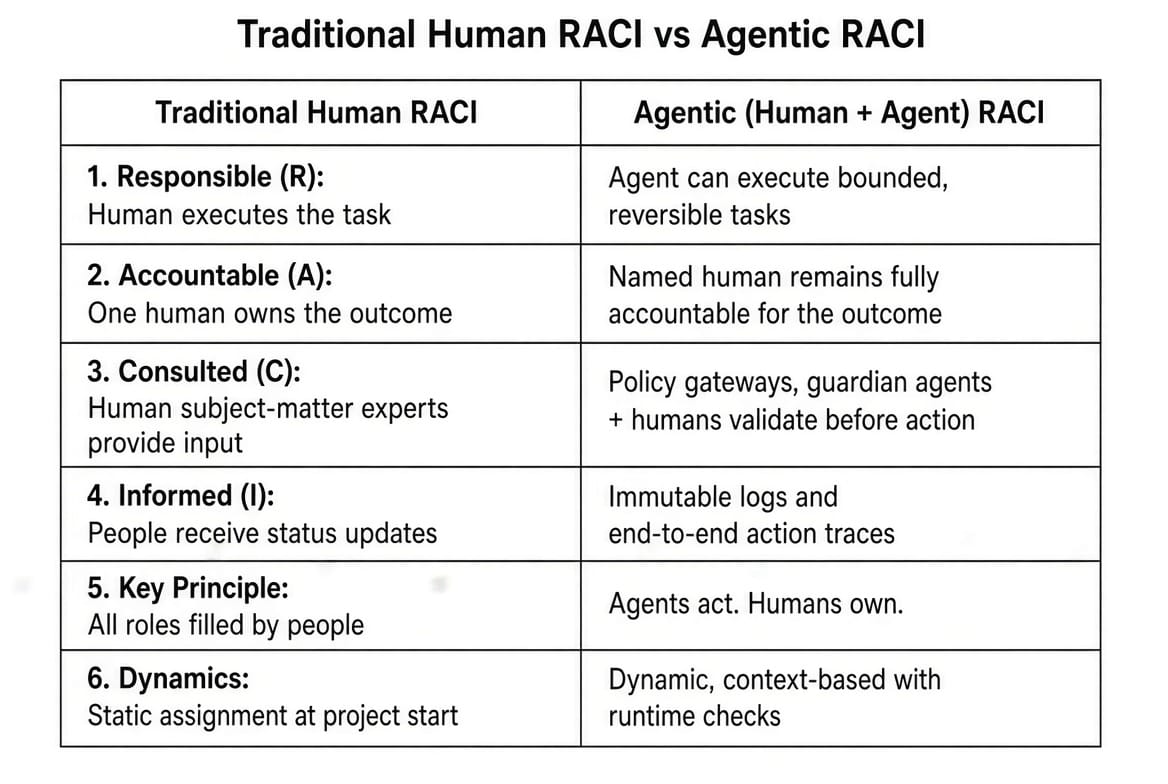
The Costs of Pretending Otherwise
Cost one: ownership diffuses. When Agent A plans a workflow, Agent B calls the tools, and Agent C executes against a production system, the question of who did this stops having a clean answer. Not because nobody acted, every step had an actor, but because the chain of actors was never mapped to a single accountable person the way the chart implied. What fills the gap is a sentence that should embarrass any organization that says it out loud: the system did it. McKinsey's recent framing of accountability in agentic organizations makes a version of this point directly, separating who owns the business outcome from who owns the platform that produced it, precisely because a single blended role stops working once the chain has more than one actor in it.
Cost two: authority expands quietly. Nobody holds a meeting to decide that an agent should now be allowed to trigger a deployment or approve a refund. It happens because an integration got turned on, a tool got added to an agent's available set, and the scope of what the agent can do grew without anyone re-approving the scope of what it is accountable for. PMI's guidance for human-agent teams is blunt about the fix: every row that expands an agent's action space needs a paired row for who reviews it, because scope and accountability drift apart the moment nobody is actively watching the gap between them.
Cost three, and the one that compounds the other two: traceability arrives late. Most organizations discover they cannot reconstruct what an agent did, what data it used, or why it took the action it took, only after something has already gone wrong, at the exact moment reconstruction matters most.
By then it is not a design choice anymore. It is an investigation.
The Test Worth Applying
Take any agent already running somewhere in your delivery pipeline and ask two questions. Can you name the single human who owns its outcome, not the team, not the department, one person. And can you reconstruct, after the fact, what it did and why, without asking the agent to explain itself after the fact. If either answer is no, the RACI chart covering that agent is decorative. It describes a division of labor built for a different kind of actor, one that could always be found and asked why, and would remember the answer the next time. This is what Traceability Must Be Designed In, Not Added After is really about: the trail has to exist before the question gets asked, not get built in response to it.
Closing
RACI was built for a world where action moved slowly enough that a human trail could keep pace with it. A person did the work, and the same person, or someone nearby, could always be found and asked why. That world produced the chart, and the chart made sense inside it. Agentic delivery does not slow down to let the chart catch up. What replaces it is not a better version of the same chart. It is traceability built into the system before it acts, not reconstructed after it fails, and one named human who cannot hand the explaining to anything else.
If you are trying to see where accountability is actually sitting in your own delivery system, the AI Coaching Agent will surface it in minutes.