I have watched this happen enough times now to stop calling it a surprise. A delivery organization adopts AI tooling, coding velocity climbs, dashboards light up green, and three months later the release calendar looks exactly the way it did before the tooling arrived. Leadership is confused. The team is confused. Everyone did what they were told would work, and the system produced the same outcome it always produces.
The confusion comes from a quiet substitution most leaders never examine. Development capacity and delivery capacity have been treated as the same number for so long that AI's arrival is now exposing the gap between them, rather than closing it.
What Development Capacity Measures
Development capacity is the throughput of one stage in a larger system: how much code a team can write, review, and merge in a given period. It is a real number, and AI has genuinely expanded it. Code that once took a sprint now takes days. That part of the story is not in dispute.
Delivery capacity is a different measurement entirely. It is the throughput of validated value reaching a customer, and it depends on every stage of the system that AI has not touched. Someone still has to decide what gets built. Someone still has to weigh it against competing priorities. Someone still has to approve it, coordinate it across dependent teams, and confirm it actually solved the problem it was meant to solve. None of those stages run faster because the code got written faster. They run at the speed they have always run, which is the speed of human judgment operating inside an organizational structure.
Treating development capacity as a proxy for delivery capacity was always an approximation. It held up reasonably well when coding was the slowest stage in the system, because a bottleneck hidden behind a bigger bottleneck rarely gets noticed. AI has removed the cover. The slowest stage is now visible, and for most organizations it was never the code.
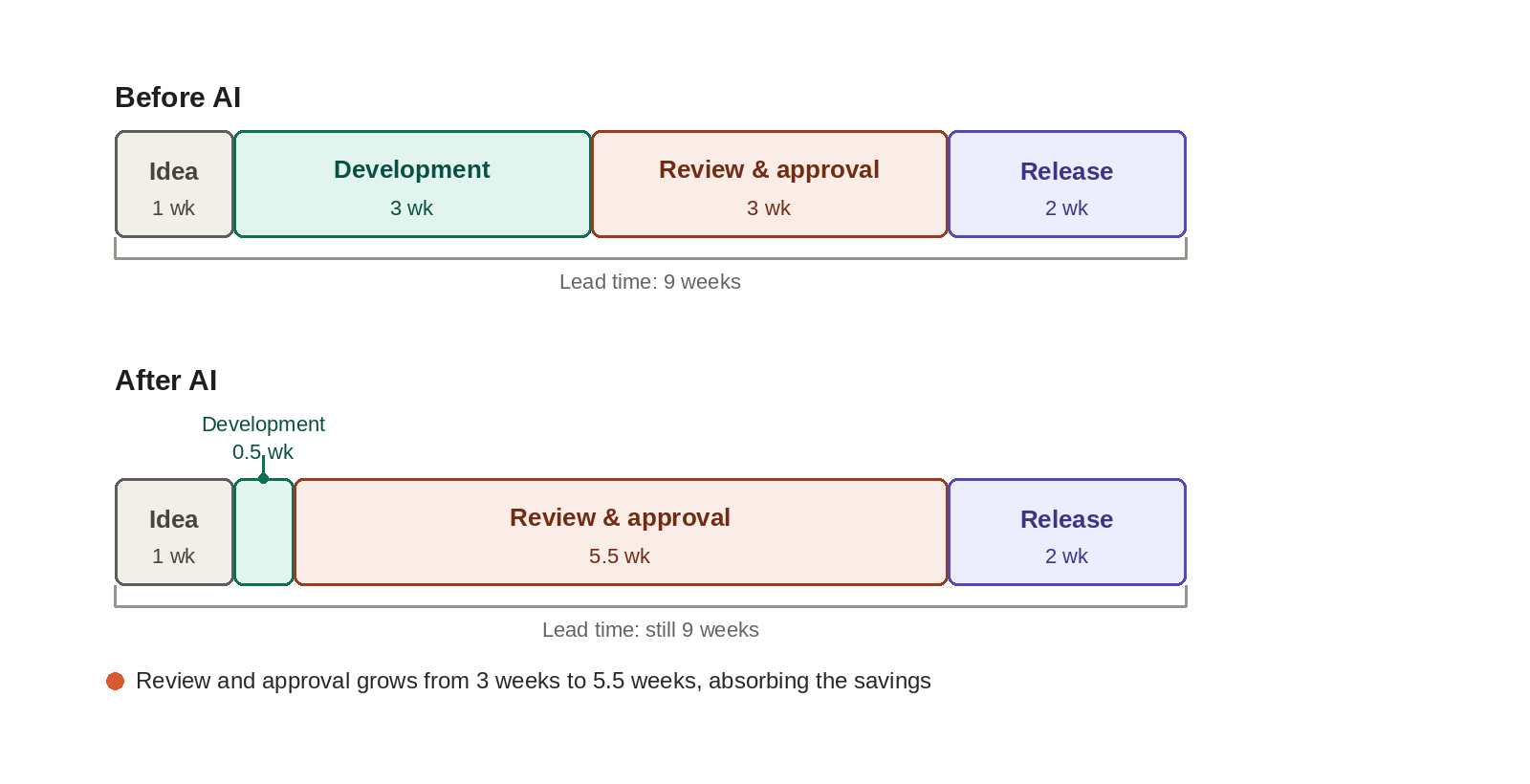
A composite delivery system with a nine week idea-to-release lead time makes this concrete. Before AI, that time is spread across four stages: a week to shape and prioritize the idea, three weeks to build it, three weeks moving through review and approval, and two weeks to release it. After AI, development collapses to half a week. Idea shaping and release hold steady, because AI never touched them. Review and approval absorbs almost the entire savings, stretching from three weeks to five and a half. The lead time from idea to delivery is nine weeks in both scenarios. The organization did not get faster. It moved its slowest stage from a place everyone was watching to a place almost no one was.
The Queue Moves, It Does Not Empty
The first cost is structural. Work produced faster does not disappear into the market faster. It arrives faster at the next constraint: the review board, the stakeholder sign-off, the release gate, the dependent team that has not finished its own piece. A queue that used to fill slowly now fills quickly, and the people running that queue are still operating on the same clock they always had. The organization has not accelerated. It has relocated its congestion to a point further downstream, usually a point with less capacity to absorb it than engineering ever had.
Decisions Become the Bottleneck Nobody Re-Measures
The second cost is harder to see because it hides inside a metric leaders trust. Velocity dashboards keep reporting gains, and those gains keep getting read as delivery health, because nobody has gone back to ask where the system's actual constraint now sits. A leader who is still managing engineering throughput as the primary lever is managing a stage of the system that stopped being the constraint months ago. The real constraint, prioritization latency, stakeholder availability, approval cycles, is running unmanaged, because it was never the thing anyone was watching.
This is the trap inside the trap. An organization can be improving the wrong number with total confidence, because the number really is improving. It is simply no longer the number that determines when value reaches anyone.
Distance From the Customer, Not Closer To It
The third cost is the one leaders find hardest to accept, because it inverts the story AI tooling is supposed to tell. More output, produced faster, without a matching increase in the organization's capacity to validate that the output is right, does not bring a team closer to its customer. It can move them further away. Volume without validation is not progress, it is exposure at scale. An organization that used to ship a handful of untested assumptions a quarter can now ship dozens, and the mechanism that was supposed to catch a bad assumption, the slow, deliberate cycle of feedback and confirmation, has not sped up to match.
Speed in production without a corresponding speed in learning is not acceleration. It is a larger and faster-moving guess.
A Test Worth Applying
Take the last delivery win your organization credited to AI. Do not trace it backward to the moment the code was written. Trace it forward. Did the decision to build that thing get made faster? Did the stakeholder who needed to weigh in actually weigh in sooner? Did the organization confirm, with real signal rather than assumption, that the thing shipped was the right thing to ship, and confirm it on a timeline that matches how fast it was built?
If the answer is no at any of those points, the organization did not get faster. It got a longer queue sitting somewhere else, and a leadership team still measuring the part of the system that no longer explains the outcome.
The System's Real Constraint
Capacity was never a single number. It is a profile across an entire system, and AI has touched exactly one point on that profile. Every other point, the human judgment about what to build, the negotiation over what matters most, the confirmation that value actually landed, still runs at the speed it always has.
The leader's job is changing because of this, whether or not the job title has caught up. Managing output stops being the differentiating skill the moment output stops being the constraint. What remains scarce, what AI cannot generate on its own, is the capability to look at a delivery system and see accurately where its real limit now sits. That capability does not come from a faster IDE. It comes from a discipline of diagnosis that most organizations have never built, because they never needed it while the bottleneck was still visible to everyone.